Order Attribution & Source Tracking for Shopify and WooCommerce.
Metorik records the UTM campaign, referring site and landing page behind each order to show you which channels drive revenue, profit, and customers who come back.
- UTM & Referrers
- Order & Customer Sources
- Filter, Segment & Export


Still guessing which channels are working?
Your ad platforms each claim the sale. Shopify leaves most orders with no conversion details. WooCommerce marks them "Unknown". Google Analytics counts sessions, not revenue.
Metorik attaches a source to every order in your own store data: the UTM source, medium and campaign, the referring site and the landing page. From there it's a report, or a couple of filters away from answering the questions that matter.
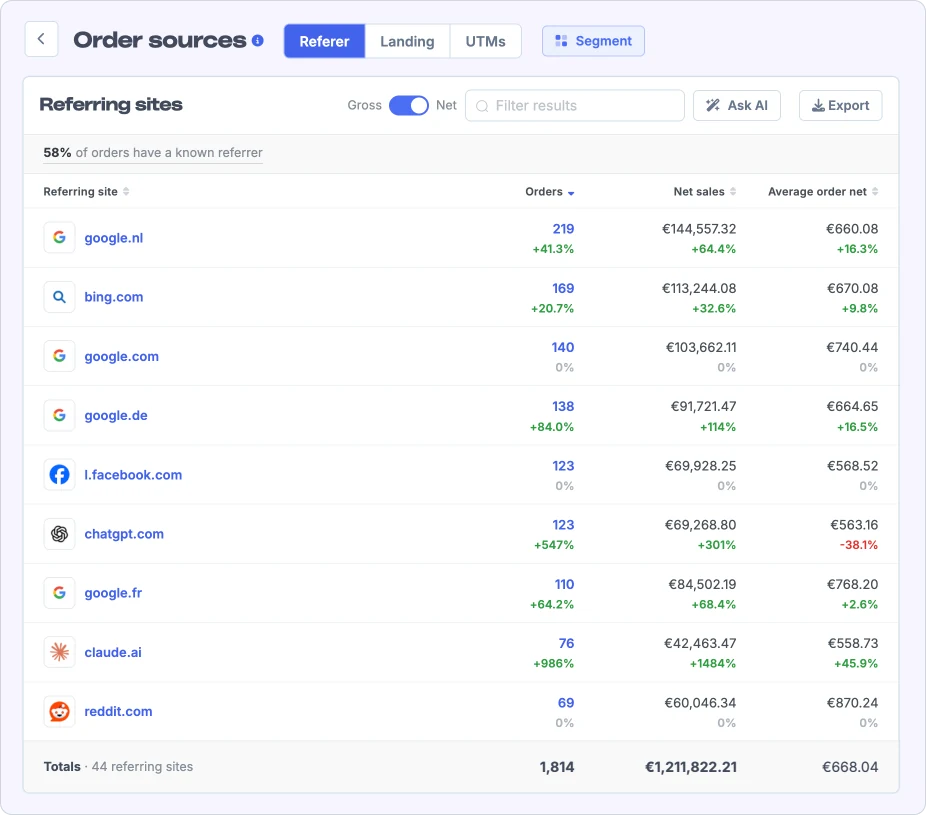
Finally see Orders and Sales by source
Metorik's Order Sources report groups every order by UTM source, medium and campaign, by referring site or by landing page, with orders, revenue and average order value beside each one.
The Customer Sources report does the same for customers, attributed to the source of their first order. So you can see not just where sales came from, but which channels bring people who come back for a second and third order.
Trusted by Shopify and WooCommerce brands around the world:


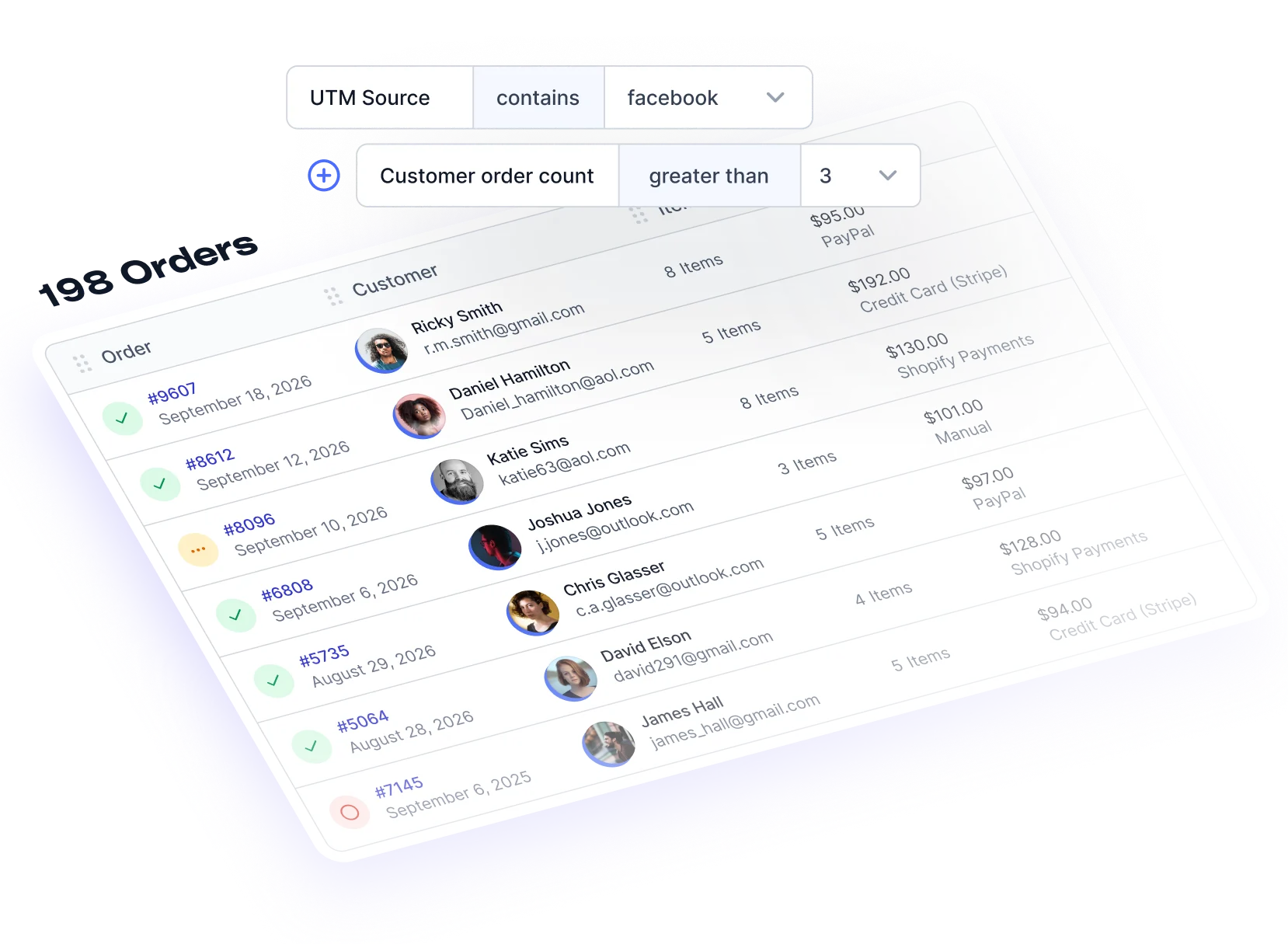
Source → Orders → Export
Metorik makes it easy to filter customers, orders, subscriptions, and even products, by source, referrer, landing page, or 500+ other attributes.
Save the result as a segment and it's available across every report. Export it to CSV with the columns you choose, including the UTM values themselves, or schedule the export to land in your inbox, Slack or Google Sheets every week.
Segments built on sources also power Engage emails and Facebook Audience Sync , so you can market to customers based on how you first found them.
Shopify, Woo, and GA4 already track sources, sort of…
Each one answers part of the question. Here's an honest look at where they stop and where Metorik picks up.

|

|

|

|
|
|---|---|---|---|---|
| Source on each order | Summary, often empty | Origin column | Sessions, not orders | UTMs, referrer and landing page |
| Orders & revenue by source | Aggregate report only | Basic overview widget | If purchase events are tagged | Orders, revenue, AOV |
| Customer source, repeat rate & LTV | All Customer Reports | |||
| Filter & export orders by source | CSV export drops source info | Column only, no filter | Yes, manually or scheduled | |
| Visit → purchase time | Depends on Shopify's cookies | Often "Unknown" | Modelled | 6-month first-click on Woo, 12‑hours on Shopify |
| Ad spend vs attributed orders | Marketing app, some platforms | Google Ads only | Google, Meta, TikTok, Pinterest, Microsoft and more | |
| Multi-touch modelling | Data-driven model | One first-party source per order | ||
| Extra cost? | Included | Included | Free | Included on every Metorik plan |
Metorik doesn't replace these. It reads the source data your platforms already have, fills the gaps, and turns it into reports you can act on, and orders you can export.
Metorik's source tracking helps you answer:
Which ad-platforms are actually profitable?
See which channels are actually driving orders with a sustainable margin. Get a ROAS from your own order data, not the platforms inflated one.
Which channel brings repeat customers?
Discover which channels are driving cheap customers that don't repurchase, and those driving higher-cost, but high-loyalty buyers.
What did that email campaign really earn?
Track your emails sent from Engage, Klaviyo, or any ESP, so your campaigns show in your sources report, with the revenue they produced.
Built on your store's own data, with the gaps filled in.
No pixel to debug, no third-party cookies, no separate attribution subscription. Your source data is stored with your orders, in your store, where it belongs.
WooCommerce Order Attribution
WooCommerce's built-in Order Attribution (the data behind the "Origin" column in your orders list) is last-click, and relies on a short session cookie, so it often shows as "Unknown" when a visitor comes back a few days later.
Metorik helps fill those gaps. It remembers the first source a visitor arrived from for six months, and when Woo has nothing recorded, Metorik attributes the order to that first click instead.
Source Tracking on Shopify
A tiny, lightweight script (1.6kb) captures the referring site and UTM parameters the moment a shopper arrives, and stores them in their cart/checkout.
Because it's recorded on arrival and held for 12 hours, the source survives even when Shopify's own conversion summary comes back empty. It also records which Engage email a customer clicked.
Each order gets one first-party source. Metorik doesn't model multi-touch credit across every touchpoint. Learn more in the WooCommerce source tracking docs and Shopify source tracking docs .
First-click or last-click? Here's the difference.
First-click attribution credits the source that introduced the customer. It can over-weight top of funnel channels, like paid social, organic search, or influencers.
Last-click attribution gives all the credit to the last source the customer interacted with right before checkout. It can over-weight conversion channels like email, retargeting, and branded search.
Neither model is wrong, they simply answer different questions. On Woo, Metorik shows the last-click source when it exists and the Metorik Helper's first-click source when it doesn't. On Shopify, Metorik records the source a shopper first arrived with and holds it for 12 hours.
Up and running in minutes:
1. Connect your store
Connect WooCommerce or Shopify to Metorik in a few clicks. All your old orders sync with any source data your platform already has.
2. Turn on tracking
On Woo, install the Metorik Helper plugin. On Shopify, enable the source tracking script from your connection settings. No developer needed.
3. Tag your links
Add UTM parameters to your ads, social posts and affiliate links. Our free UTM builder helps keep them consistent.
Order Attribution & Source Tracking FAQs
Can't find what you're looking for below? Read our Help Docs
How does Metorik know where an order came from?
Metorik records and stores the UTM parameters, referring site and landing page for every customer, and links that source to the order at checkout.
On WooCommerce it reads WooCommerce's native attribution fields, and then fills in any gaps with the Metorik Helper plugin's own tracking. On Shopify a tiny script stores the source in the cart and Metorik saves it to the order once placed.
Is Metorik's source tracking first-click or last-click?
Both. WooCommerce's native attribution is last-click. Metorik uses that if it exists. When it doesn't, Metorik reverts to the Metorik Helper's first-click tracking, which remembers the first source a visitor arrived from for 6 months.
On Shopify, Metorik records the source when the shopper first arrives and holds it for 12 hours, so a later visit the same day doesn't change it. Read the full first-click vs last-click explanation.
Why do so many of my WooCommerce orders show an unknown origin?
WooCommerce's native attribution relies on a short session cookie. A potential buyer who clicks an ad, leaves, and then comes back a few days later is often recorded as Unknown or Direct.
Why do most of my Shopify orders have no conversion details?
Shopify's conversion summary depends on its analytics cookies, which browsers like Safari block or expire early. Metorik's Shopify source tracking records the referrer and UTM parameters in the shopper's cart when they arrive, so the source travels with the order even when Shopify's summary is empty.
Can I export a list of orders by traffic source or UTM campaign?
Yes. Filter orders by UTM source, medium, campaign, referring site, landing page, or hundreds more filters, then export the matching orders to CSV with whichever columns you want, including the UTM values.
Does source tracking work with Google Ads, Meta, TikTok and other paid channels?
It works with any channel that sends UTM parameters or a referrer, which covers Google Ads, Meta, TikTok, Pinterest, Microsoft, AppLovin, affiliates, influencer links and email.
Is this multi-touch attribution?
No. Metorik gives each order one first-party source, recorded in your own store data. It doesn't split credit across every touchpoint. It answers the questions most stores have: which channels bring orders, which bring customers who come back, and how much revenue each campaign produced.
Does it track sources for orders placed before I connected Metorik?
On WooCommerce, Metorik imports whatever Order Attribution data WooCommerce already stored on each older order. On Shopify, Metorik reads the referrer and UTM details Shopify saved with older orders, where they exist. Tracking through the Metorik Helper and the Shopify script starts from the day you enable it.

Still have questions?
Can't find the answer you're looking for? Chat to our friendly team.

Finally know where your best customers are coming from. Free for 30-Days.
Metorik is just a few clicks to connect — no developers required.
💳 Metorik is Free for 30 days, no credit card required.