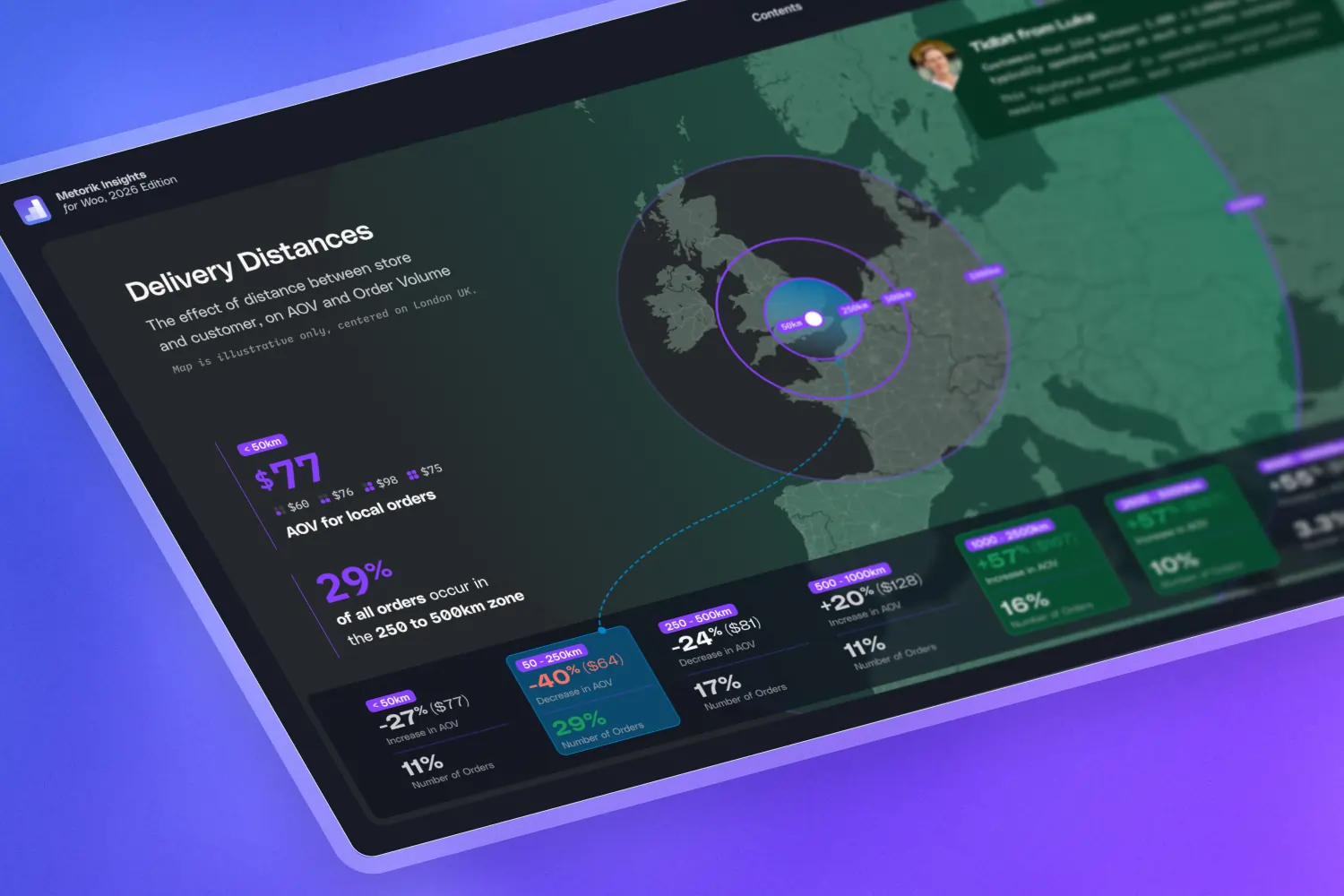

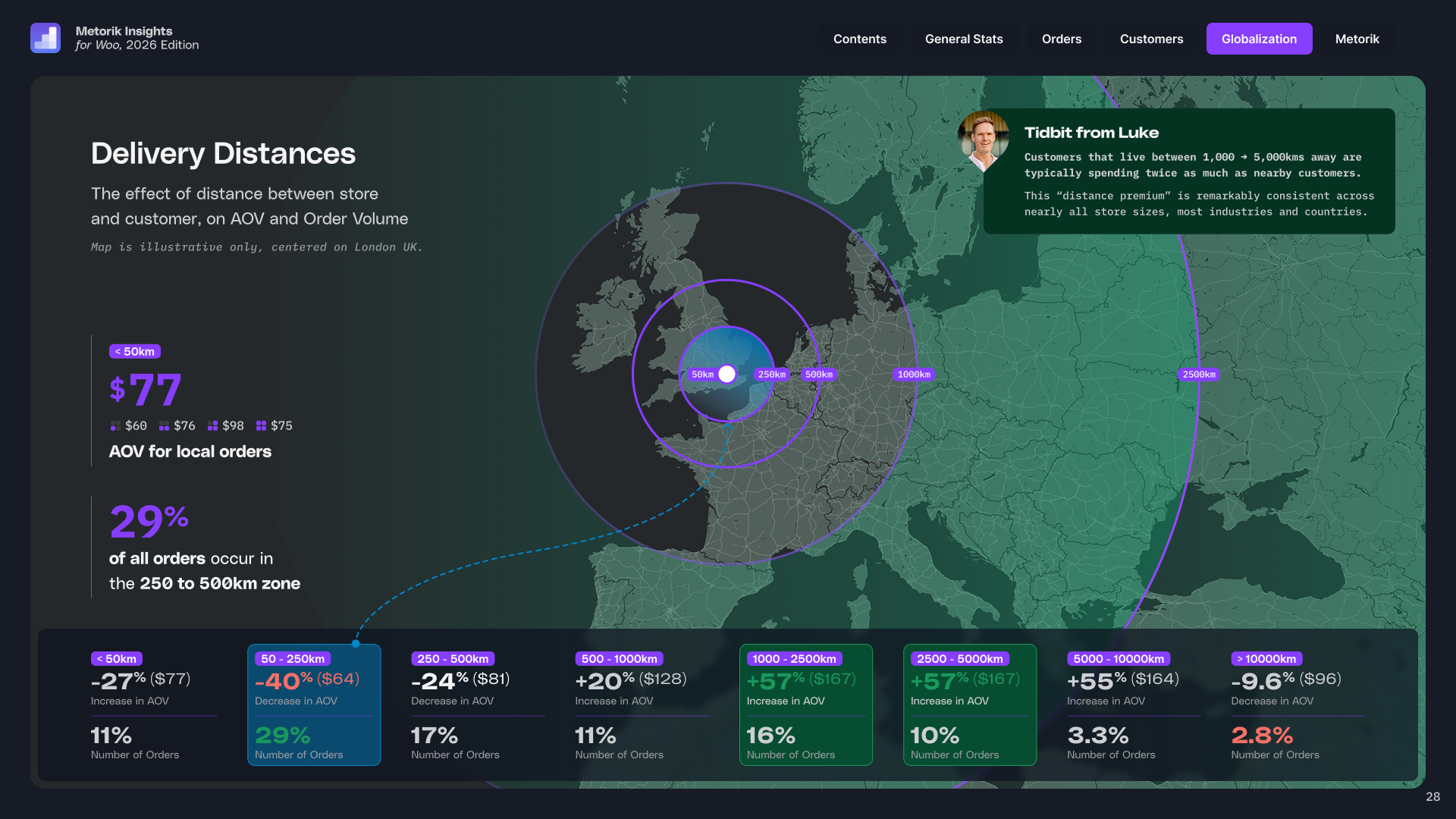
Here's a pattern almost no one tracks: the farther away a customer lives, the more they tend to spend. Metorik's analysis of 65M+ orders across 6,000+ stores found that customers 1,000–5,000km from a store spend roughly twice as much per order as nearby buyers — $167 versus about $77. And this "distance premium" holds remarkably steady across store sizes, industries, and countries.
Average order value by delivery distance
Distance from store | Average order value | vs $105 average | Share of orders |
|---|---|---|---|
Under 50 km | $77 | −27% | 11% |
50–250 km | $64 | −40% | 29% |
250–500 km | $81 | −24% | 17% |
500–1,000 km | $128 | +20% | 11% |
1,000–2,500 km | $167 | +57% | 16% |
2,500–5,000 km | $167 | +57% | 10% |
5,000–10,000 km | $164 | +55% | 3.3% |
Over 10,000 km | $96 | −9.6% | 2.8% |
Two things stand out. First, the 50–250km zone drives the largest share of all orders (29%) — but also the lowest AOV. Second, AOV climbs steadily with distance up to the 1,000–5,000km band, then tapers past 10,000km.
Why distance correlates with spend
The most likely explanation is a selection effect: buying from a distant store usually means added friction — longer shipping times, higher shipping cost, sometimes customs. Only motivated, higher-intent buyers push through that friction, and they tend to place larger, more deliberate orders. Nearby customers, by contrast, buy more casually and more often, in smaller baskets. It's the same dynamic that makes cross-currency orders worth ~20% more than domestic ones.
What to do with this
This reframes how to think about distant customers. They're not a fringe to ignore — buyers in the 1,000–5,000km band alone account for over a quarter of orders, at the highest values in the dataset. Practical moves: don't suppress distant traffic in ad targeting just because it's far; make sure international and long-distance shipping options are visible and not needlessly punitive; and segment your AOV by customer distance before assuming your local market is your most valuable one. For many stores, it isn't.
FAQ
Do customers who live farther away spend more?
Yes. In this dataset, customers 1,000–5,000km from a store spent roughly twice as much per order as local buyers — about $167 versus $77.
Which delivery distance produces the most orders?
The 50–250km zone, at 29% of all orders — though it also has one of the lowest average order values.
Why would distant customers spend more?
Likely a selection effect: buying from a distant store carries more friction (shipping time, cost, customs), so only higher-intent buyers complete those purchases, and they tend to order more.
Methodology
Based on 65M+ WooCommerce orders placed in 2025 across a randomized sample of 6,000+ stores using Metorik. The distance premium is consistent across nearly all store sizes, industries, and countries. Full data: the 2026 Metorik Insights for WooCommerce report and the key statistics page.
Metorik's segmentation lets you slice orders and customers by almost any property — including geography — so you can find the high-value segments hiding in your own store.