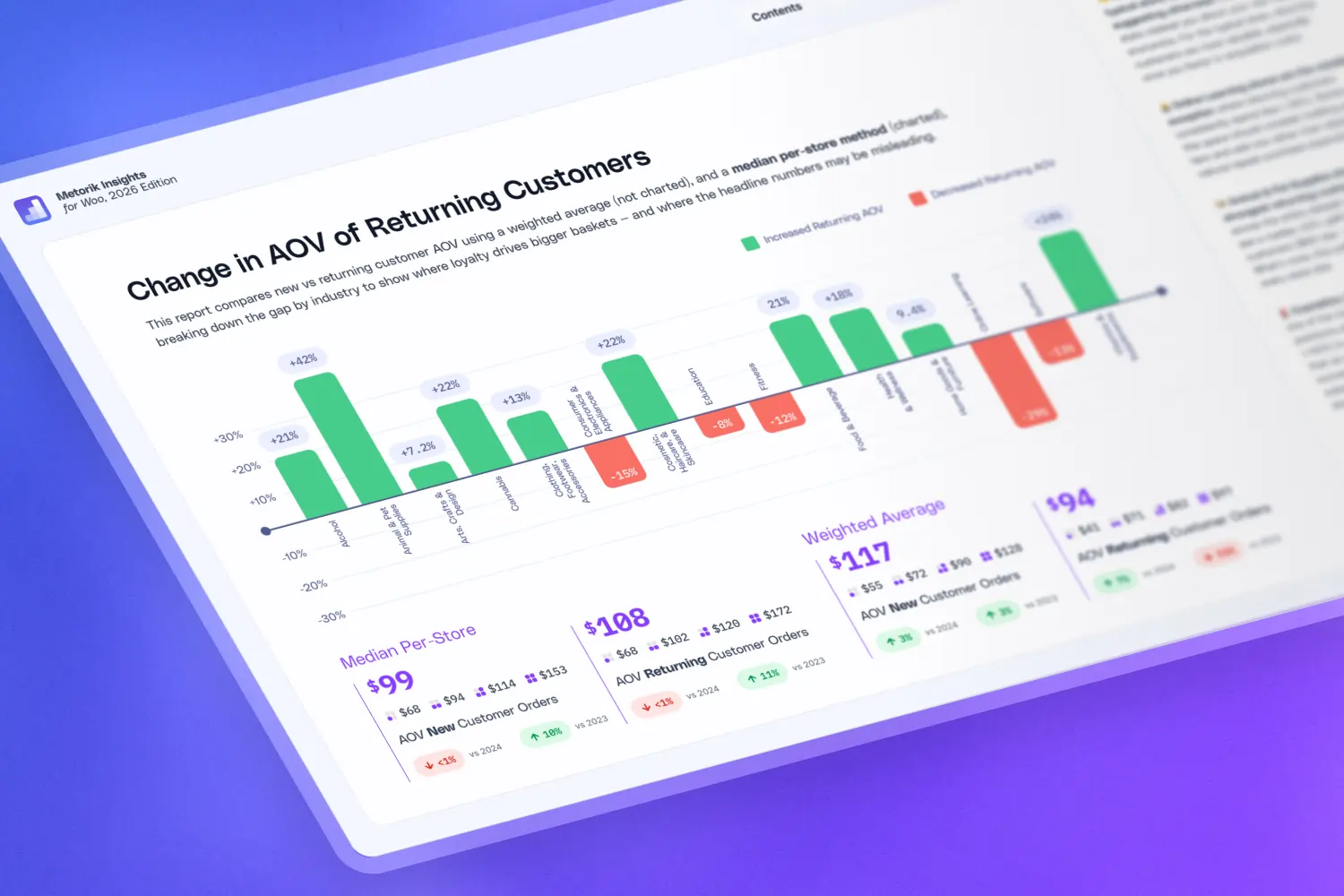

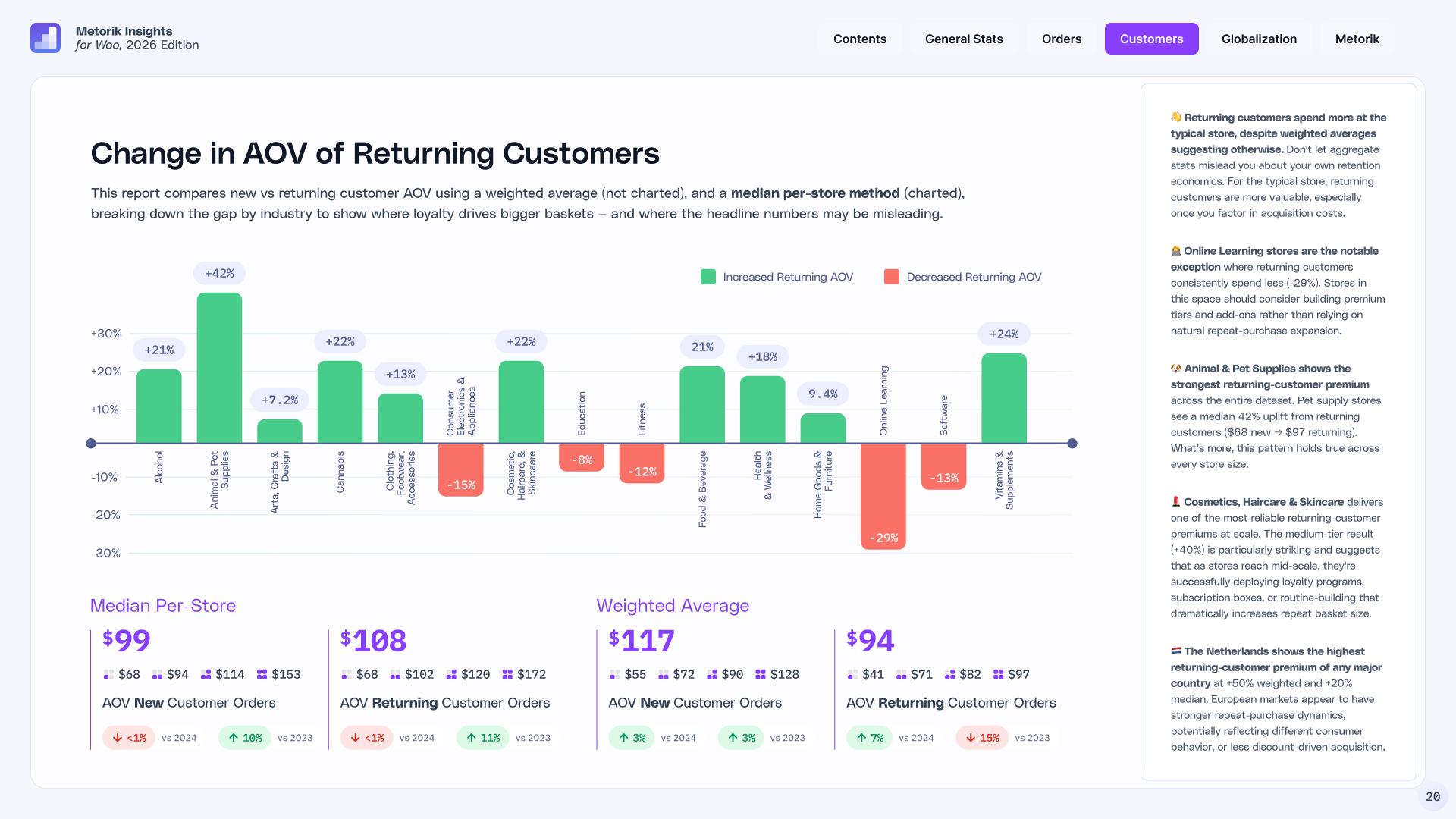
At the typical WooCommerce store, returning customers spend $108 per order versus $99 for new customers — a real but modest premium. The more useful finding from Metorik's analysis of 65M+ orders is that this premium swings enormously by industry: in some categories returning customers spend 40%+ more, while in others they spend less. Averages will mislead you here, so segment before you assume.
The headline: it depends how you measure
Per-store median: new customer orders $99, returning $108 — returning customers worth more.
Weighted average: new $117, returning $94 — the relationship reverses.
Why the contradiction? Weighted averages give more influence to high-volume stores, where heavy repeat buyers placing many smaller orders pull the returning-customer figure down. For your own store, the per-store view is usually the more honest measure of whether retention is paying off.
Returning-customer AOV uplift by industry
Per-store median, returning vs new:
Industry | Returning-customer AOV uplift |
|---|---|
Animal & Pet Supplies | +42% |
Vitamins & Supplements | +24% |
Cannabis | +22% |
Cosmetics, Haircare & Skincare | +22% |
Alcohol | +21% |
Food & Beverage | +21% |
Health & Wellness | +18% |
Clothing, Footwear & Accessories | +13% |
Home Goods & Furniture | +9.4% |
Arts, Crafts & Design | +7.2% |
Education | −8% |
Fitness | −12% |
Software | −13% |
Consumer Electronics & Appliances | −15% |
Online Learning | −29% |
What the negatives mean
The categories where returning customers spend less aren't failing at retention — they have a different shape. In Online Learning (−29%), the first purchase is often the big-ticket flagship course, and later purchases are smaller add-ons. Same story for software and electronics: the headline product comes first, accessories and renewals follow. For these categories, the lesson isn't "fix repeat spend" — it's that repeat expansion won't happen on its own, so premium tiers, bundles, and upsells have to be engineered deliberately.
A geographic note
The Netherlands has the highest returning-customer premium of any major market (+50% weighted, +20% median), and European markets generally show stronger repeat-purchase dynamics.
What to do with this
Find your category above, then check your own store against it. If you sell consumables (pet, supplements, food) and returning customers aren't spending meaningfully more, your retention or replenishment flows have room to work. If you sell considered or one-off products and see a negative uplift, that's expected — focus on engineered upsells rather than hoping for natural repeat growth.
FAQ
Do returning customers spend more than new customers?
At the typical WooCommerce store, yes: $108 vs $99 per order. But the gap reverses on a weighted average and varies sharply by industry.
Which industry has the biggest returning-customer premium?
Animal & Pet Supplies, at +42%, followed by Vitamins & Supplements (+24%) and Cannabis (+22%).
Why do returning customers spend less in some categories?
In categories like Online Learning (−29%) and Software (−13%), the first purchase is the high-ticket item and later purchases are smaller add-ons — so repeat expansion has to be designed rather than assumed.
Methodology
Based on 65M+ WooCommerce orders placed in 2025 across a randomized sample of 6,000+ stores using Metorik. Uplift figures use the per-store median; industry breakdowns require a minimum of 50 stores. Full data: the 2026 Metorik Insights for WooCommerce report and the key statistics page.
Metorik's customer cohorts and segmentation show exactly how your returning customers behave versus new ones — by industry-style segment, product, and acquisition source.