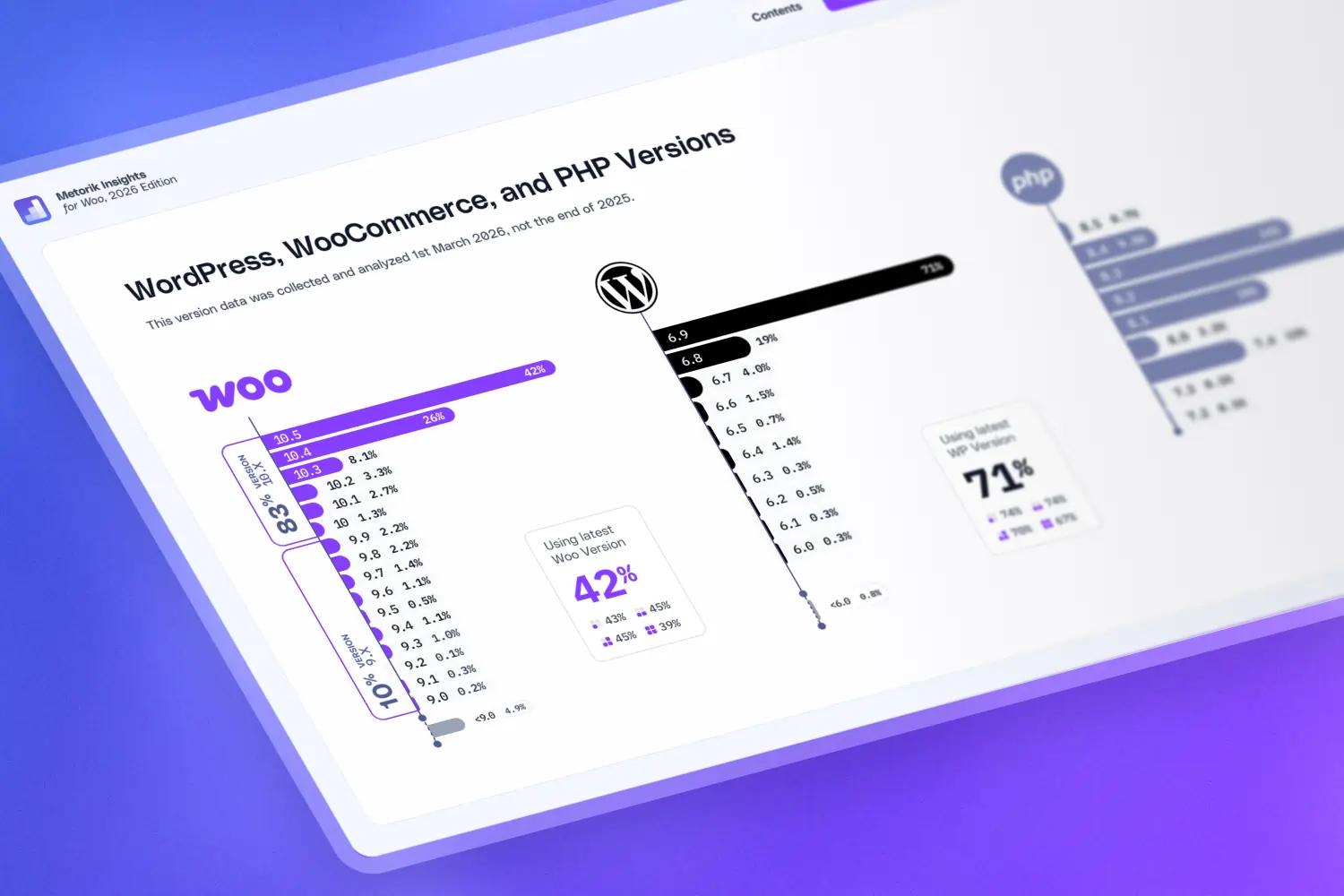

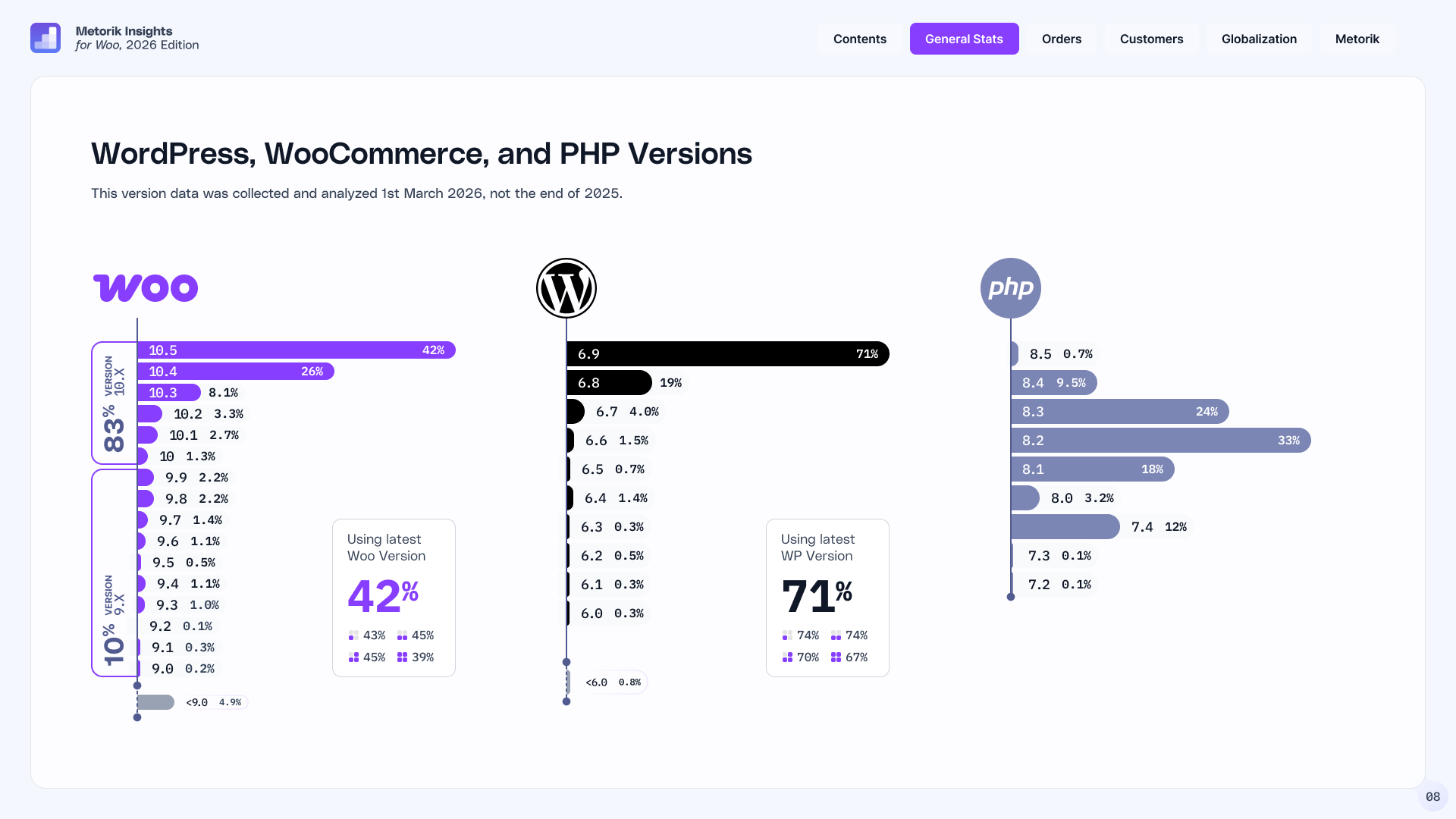
PHP 8.2 is the most common PHP version on WooCommerce stores, running on 33% of them — but roughly 12% are still on PHP 7.4, which no longer receives security updates. Metorik's scan of a randomized sample of 6,000+ WooCommerce stores (version data collected 1 March 2026) shows an ecosystem that's mostly current, with a meaningful minority running well behind.
PHP version adoption
PHP version | Share of stores |
|---|---|
8.2 | 33% |
8.3 | 24% |
8.1 | 18% |
8.4 | 9.5% |
7.4 | ~12% |
8.0 | 3.2% |
8.5 | 0.7% |
The PHP 8.x line dominates, but the ~12% still on 7.4 is the figure worth flagging: it's past end-of-life, so those stores aren't getting security patches and miss the substantial performance gains of newer releases. For a store handling payments, that's a real risk surface, not a cosmetic lag.
WooCommerce version adoption
WooCommerce version line | Share of stores |
|---|---|
Latest (10.5) | 42% |
10.x line overall | 83% |
9.x line | 10% |
Below 9.0 | 4.9% |
Within the 10.x line: 10.5 is 42%, 10.4 is 26%, 10.3 is 8.1%, and the remainder trail off below that. Adoption of the current major version is healthy — most stores are within one or two releases of the latest.
WordPress version adoption
WordPress version | Share of stores |
|---|---|
Latest (6.9) | 71% |
6.8 | 19% |
6.7 | 4.0% |
WordPress core sees the fastest uptake of the three — 71% are on the latest version, reflecting how aggressively WordPress prompts and auto-updates core.
Why this matters
The pattern across all three is the same: the majority stay current, a long tail lags, and the lag is concentrated at the infrastructure layer (PHP) rather than the application layer (WordPress/Woo). That ordering makes sense — WordPress and WooCommerce nag you to update inside the dashboard, while PHP is set at the host level and quietly forgotten. If you're going to audit one thing, audit your PHP version: it's the update most likely to be silently out of date, and the one with the steepest security and performance consequences. Pair that with the finding that 56% of stores don't use a child theme and the average store runs 58 plugins, and the stores most at risk are the ones running a heavy plugin stack on an old PHP version.
FAQ
What PHP version do most WooCommerce stores run?
PHP 8.2 is the most common, on 33% of stores, followed by 8.3 (24%) and 8.1 (18%). About 12% still run end-of-life PHP 7.4.
What percentage of stores are on the latest WooCommerce version?
42% run the latest version (10.5), and 83% are on the current 10.x line overall.
Is it safe to run PHP 7.4 for WooCommerce?
PHP 7.4 is past end-of-life and no longer receives security updates, so running it on a store that processes payments carries real security and performance risk. Roughly 12% of stores are still on it.
Methodology
Based on a randomized sample of 6,000+ WooCommerce stores using Metorik, with version data collected 1 March 2026 (not end of 2025). Figures are descriptive shares of stores. Full data: the 2026 Metorik Insights for WooCommerce report and the key statistics page.
Metorik connects to your store externally for analytics and reporting — full insight into your data without adding to your plugin or infrastructure load.