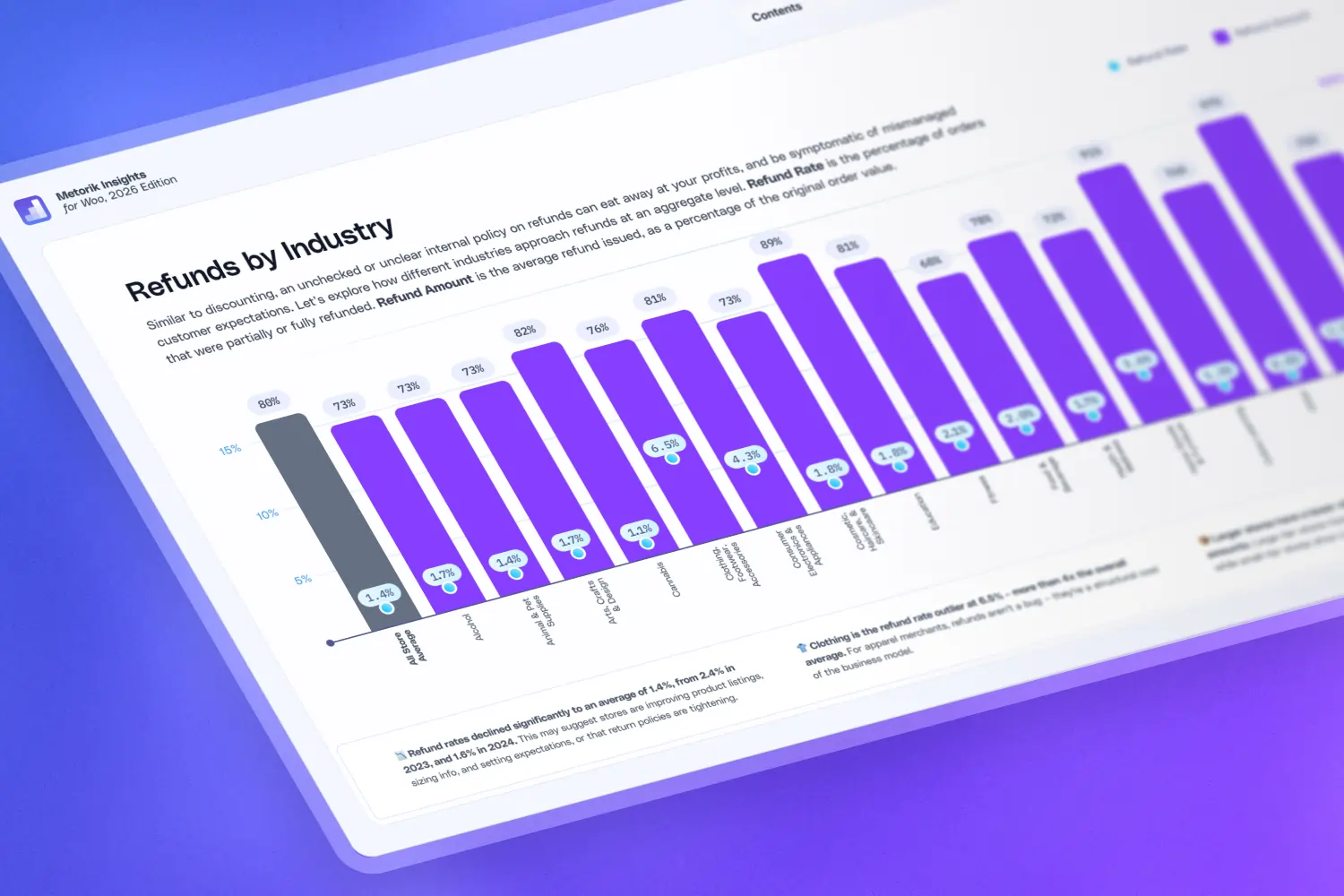

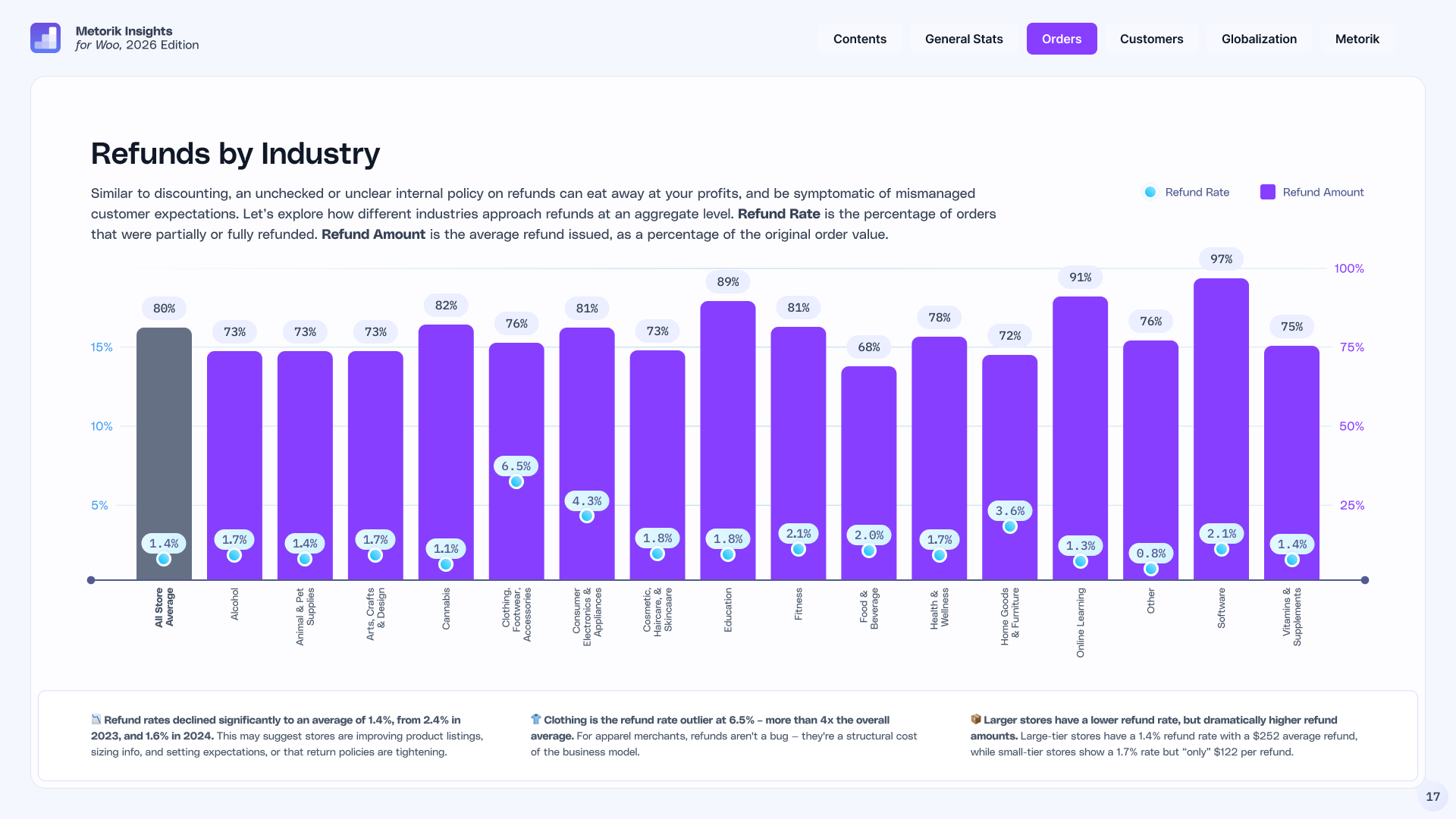
The average WooCommerce refund rate was 1.4% of orders in 2025 — down from 2.4% in 2023. That decline, from Metorik's analysis of 65M+ orders across 6,000+ stores, is one of the clearer positive trends in the data. But the average masks a huge spread: apparel refunds run more than 4x higher, and larger stores refund less often while refunding far more per order.
The trend: refunds are falling
Year | Average refund rate |
|---|---|
2023 | 2.4% |
2024 | 1.6% |
2025 | 1.4% |
A falling refund rate can mean two different things, and both are probably happening: stores are getting better at setting expectations — clearer product listings, better sizing information, sharper photography — and some are tightening return policies. Either way, fewer orders are coming back.
The outlier: Clothing at 6.5%
Clothing is the refund-rate outlier at 6.5% — more than 4x the overall average. For apparel, refunds aren't a defect to eliminate; they're a structural cost of selling fit-dependent products online, where customers routinely buy multiple sizes intending to return some. If you sell apparel, your benchmark is the category, not the all-store average — and a rate in the mid-single digits is normal rather than alarming.
Rate vs amount: bigger stores refund less often, but more
Refund rate and refund amount move in opposite directions as stores grow:
Store tier | Refund rate | Average refund amount |
|---|---|---|
Small ($50k–$250k) | 1.7% | $122 |
Large ($1M+) | 1.4% | $252 |
Larger stores refund a smaller share of orders but a larger dollar amount per refund — a reflection of higher average order values and, often, more considered (and more expensive) products. The headline rate alone won't tell you your refund exposure; you have to weight it by what's actually being refunded.
What to do with this
Benchmark against your category, not the global 1.4%. If you're a general store sitting well above 2%, that's worth investigating — listings, sizing, shipping damage, or expectation gaps. If you sell apparel, focus less on the rate and more on the economics: bundle sizing guidance, exchange-over-refund flows, and tracking refund cost against margin rather than chasing a lower percentage for its own sake.
FAQ
What is a good refund rate for an ecommerce store?
The average WooCommerce refund rate in 2025 was 1.4% of orders. Most categories sit near or below this; apparel is the major exception at 6.5%.
Which industry has the highest refund rate?
Clothing, at 6.5% — more than four times the overall average — because fit-dependent apparel is returned far more often than other products.
Do larger stores have higher refund rates?
No — larger stores refund a smaller share of orders (1.4% vs 1.7% for small stores) but a much larger dollar amount per refund ($252 vs $122), reflecting higher order values.
Methodology
Based on 65M+ WooCommerce orders placed in 2025 across a randomized sample of 6,000+ stores using Metorik. Refund rate is the share of orders partially or fully refunded; industry breakdowns require a minimum of 50 stores. Full data: the 2026 Metorik Insights for WooCommerce report and the key statistics page.
Metorik tracks refunds alongside revenue, profit, and product performance, so you can see refund exposure by product, customer, and segment — not just a single store-wide rate.